
Medical Records Management: Improving Healthcare Efficiency Through Accurate Medical Record Indexing
Operomed Business Solutions is a trusted provider of Revenue Cycle Management services, serving healthcare providers across specialties for over 21 years. We combine experience, technology, and compliance expertise to deliver accurate billing, clean claims, and faster reimbursements — allowing practices to focus on patient care.

Introduction
Medical information plays an essential role in delivering quality healthcare. Hospitals, clinics, physicians, and medical billing companies handle large volumes of patient documents every day, including medical charts, diagnostic reports, scanned documents, laboratory results, consultation notes, and insurance-related records. Managing this information efficiently is important for maintaining organized patient records and supporting smooth healthcare operations.
Medical Records Management helps healthcare organizations organize, maintain, and retrieve patient information when it is needed. However, when documents are received in different formats and stored without proper categorization, locating specific information can become time-consuming. This is where professional medical record indexing becomes valuable.
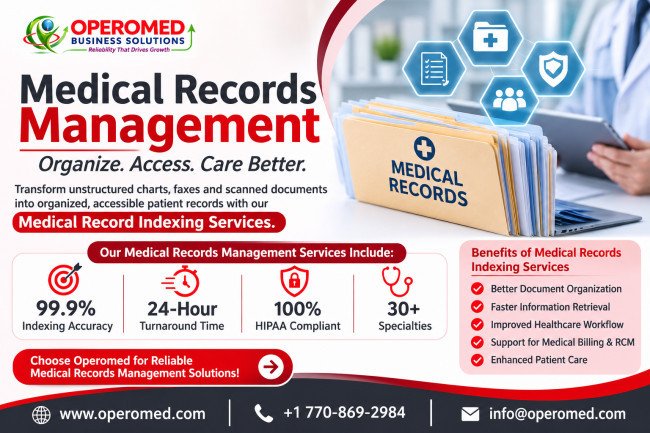
Operomed provides solutions designed to transform unstructured charts, faxes, scanned PDFs, and diagnostic notes into organized, discrete EHR data. Through accurate Medical Records Management, healthcare organizations can improve document accessibility and support more efficient information management.
What Is Medical Records Management?
Medical Records Management refers to the organized handling of patient healthcare documents throughout their lifecycle. It involves arranging, categorizing, maintaining, and retrieving medical information so authorized healthcare professionals can access relevant records when required.
Healthcare documentation may include:
-
Patient medical histories
-
Physician consultation notes
-
Laboratory and diagnostic reports
-
Referral documents
-
Scanned medical charts
-
Insurance and billing documentation
-
Clinical correspondence
-
External healthcare records
Without an organized process, these documents may be difficult to locate, particularly when healthcare providers manage information from multiple sources.
An effective Medical Records Management process supports structured documentation and helps healthcare teams find relevant patient information more efficiently.
Understanding Medical Record Indexing
Medical record indexing is the process of identifying, classifying, and organizing healthcare documents according to relevant patient and document information. It helps convert incoming documents into structured records that can be associated with the appropriate patient chart and document category.
For example, a healthcare organization may receive laboratory reports, consultation notes, and scanned referral documents through different channels. Proper indexing helps categorize these documents so they can be located more easily within the electronic health record system.
Professional Medical Records Indexing supports better document organization by making important patient information easier to access.
Why Are Medical Record Indexing Services Important?
Healthcare organizations depend on accurate patient information to coordinate administrative and clinical activities. When medical documents are not properly organized, staff members may spend additional time searching for records.
Professional Medical Record Indexing Services help address common documentation challenges.
1. Better Document Organization
Medical documents can arrive in different formats, including scanned PDFs, faxes, charts, and diagnostic notes. Indexing helps categorize these documents and organize them within the appropriate patient records.
With structured Medical Records Management, healthcare organizations can maintain a more consistent approach to document organization.
2. Faster Information Retrieval
Searching through unorganized documents can delay administrative workflows. Proper indexing makes it easier for authorized users to locate specific reports, notes, and other patient-related documents.
Efficient Medical Record Indexing Services help reduce unnecessary document-searching time.
3. Improved Healthcare Workflow
Physicians, administrative teams, and medical billing professionals regularly depend on patient documentation. Organized records can support smoother coordination between departments and help staff access relevant information when needed.
4. Support for Medical Billing and RCM
Medical billing and revenue cycle management companies often require access to patient documentation for coding lookups, clean claim preparation, and audit appeals. Organized medical records can make supporting information easier to retrieve.
Structured Medical Records Management can therefore support administrative activities connected with medical billing and revenue cycle operations.
5. Better Access to Patient Information
During appointments, care teams may need to review outside clinical records, diagnostic reports, or previous consultation notes. Organized indexing helps make these documents more accessible within the patient chart.
Who Benefits from Medical Record Indexing?
Medical record indexing can support different types of healthcare organizations and service providers.
Hospitals and Multi-Specialty Clinics
Hospitals and multi-specialty clinics receive large volumes of documents from patients, laboratories, specialists, and external healthcare providers. These may include incoming faxes, consultation notes, and laboratory reports.
Indexing helps categorize these documents within patient charts, supporting more efficient document retrieval.
Medical Billing and RCM Companies
Medical billing and revenue cycle management companies work with documentation required for coding, claims generation, and audit-related activities. Access to properly organized documents can help teams locate relevant information during their workflows.
Professional Medical Records Indexing can support document retrieval for clean claims generation, coding lookups, and audit appeals.
Physicians and Care Teams
Physicians and care teams may need to review external clinical records before or during patient appointments. When these documents are properly indexed, healthcare professionals can spend less time searching for information and more time focusing on patient-related activities.
How Medical Record Indexing Works
A structured indexing workflow generally involves several important steps. The exact process may vary depending on the healthcare organization's documentation requirements and systems.
Step 1: Document Receipt
The process begins when medical documents are received through available channels. These may include scanned PDFs, faxes, medical charts, diagnostic notes, and other healthcare documents.
Step 2: Document Identification
The received documents are reviewed to identify the type of information they contain. This may include laboratory reports, consultation notes, referrals, and other clinical records.
Step 3: Patient and Document Identification
Relevant patient and document information is identified so the records can be associated with the appropriate patient chart. Accuracy during this stage is important to avoid incorrect document association.
Step 4: Categorization and Indexing
Documents are classified according to their type and relevant indexing information. This creates a more organized structure for storing and retrieving patient records.
Step 5: EHR Data Organization
The indexed documents are organized into discrete EHR data, helping make critical patient details more accessible within the electronic health record environment.
Step 6: Retrieval and Accessibility
Once documents are properly organized, authorized users can retrieve relevant records when required for clinical or administrative workflows.
A consistent Medical Records Management workflow helps healthcare organizations maintain better control over incoming documentation.
Common Challenges in Medical Records Indexing
Although indexing provides important operational benefits, healthcare organizations may face challenges when managing large volumes of medical documents.
Unstructured Documents: Documents received in different formats may require identification and categorization before they can be organized.
Incomplete Information: Missing or unclear patient details can make document identification more difficult.
High Document Volumes: Hospitals and multi-specialty clinics may receive substantial numbers of documents every day, creating additional administrative workload.
Document Retrieval Delays: Poorly categorized records can make it difficult for staff to locate specific patient information.
Incorrect Document Association: Associating a document with the wrong patient chart can create serious administrative and clinical concerns. Careful identification and verification are important.
Professional Medical Record Indexing Services can help healthcare organizations address documentation challenges through structured indexing practices.
The Role of Technology in Medical Records Management
Technology plays an important role in modern healthcare documentation. Electronic health record systems allow healthcare organizations to store and access patient information digitally. However, incoming documents may still arrive in multiple formats, including faxes, scanned PDFs, and external clinical records.
Medical record indexing helps organize these documents into structured EHR data. This supports more convenient access to relevant patient details and helps reduce the time spent searching through unorganized files.
A well-organized Medical Records Management approach can complement existing EHR and practice management workflows.
Why Choose Operomed for Medical Record Indexing?
Operomed Business Solutions supports healthcare organizations with medical record indexing designed to improve the organization and accessibility of patient documentation.
The service page highlights the transformation of unstructured charts, faxes, scanned PDFs, and diagnostic notes into neatly organized, discrete EHR data.
Operomed also highlights the following service information:
-
99.9% Indexing Accuracy: A stated indexing accuracy figure.
-
24-Hour Turnaround Time: A stated turnaround time.
-
100% HIPAA Compliant: A stated compliance commitment.
-
30+ Specialties: Experience supporting multiple medical specialties.
These service details reflect Operomed's focus on organizing healthcare documentation and making critical patient information accessible.
By using Medical Record Indexing Services, healthcare organizations can support document organization for hospitals, multi-specialty clinics, medical billing and RCM companies, physicians, and care teams.
Medical Records Management and HIPAA Considerations
Patient medical records contain confidential information that must be handled responsibly. Healthcare organizations should ensure that access to patient documentation is limited to authorized individuals and that appropriate privacy and security practices are followed.
Medical record indexing workflows should support careful document handling, accurate patient identification, and appropriate access controls. Organizations should also follow their applicable privacy, security, and regulatory requirements.
A structured Medical Records Management process can help maintain organized documentation while supporting responsible handling of patient information.
How to Choose the Right Medical Record Indexing Partner
Selecting a suitable indexing partner is an important decision for healthcare organizations. Before choosing a service provider, consider the following factors:
-
Accuracy: Check the provider's stated indexing accuracy and quality-control approach.
-
Turnaround Time: Understand how quickly documents can be processed and made accessible.
-
Healthcare Experience: Consider experience supporting different specialties and healthcare workflows.
-
EHR Compatibility: Confirm whether the service can work with the organization's existing EHR environment.
-
Privacy and Security: Review the provider's approach to protecting confidential patient information.
-
Scalability: Consider whether the service can support changing document volumes and operational requirements.
Choosing an appropriate Medical Records Indexing partner can help healthcare organizations build a more organized documentation workflow.
Conclusion
Efficient medical documentation is essential for healthcare organizations that manage large volumes of patient information. Unstructured charts, scanned PDFs, faxes, and diagnostic notes can create document-management challenges when they are not properly organized.
Medical Records Management and professional medical record indexing help transform incoming healthcare documents into organized, accessible EHR data. This supports document retrieval for hospitals, multi-specialty clinics, physicians, care teams, and medical billing and RCM companies.
Operomed focuses on organizing medical documentation so critical patient details can be accessed more efficiently. Healthcare organizations looking to improve their document organization workflows can explore Medical Record Indexing Services and learn more about how Medical Records Management can support their operational needs.
For more information about Operomed's service, visit the Medical Records Indexing page and connect with the team to understand the available solutions for your healthcare documentation requirements.










Comments
0 comment