
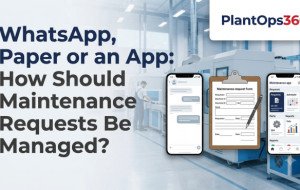
WhatsApp, Paper or a Maintenance Request App: How Should Maintenance Requests Be Managed?
Maintenance requests can be managed through WhatsApp, paper forms, or a dedicated maintenance request app. While WhatsApp and paper are simple, an app provides better tracking, faster communication, clear assignment of tasks, and a complete record of maintenance activities.

WhatsApp, Paper or a Maintenance Request App: How Should Maintenance Requests Be Managed?
Maintenance requests often start with a simple message: a machine has stopped, an unusual sound was noticed, or something needs inspection. The real challenge is what happens next.
WhatsApp and paper can handle basic communication, but they often make tracking, ownership, and history difficult. A maintenance request app creates a structured process where requests can be logged, assigned, updated, and closed without losing important information.
For manufacturers, the right method depends on request volume, plant size, and how much visibility the maintenance team needs.
How Are Maintenance Requests Commonly Managed?
Many plants begin with simple methods because they are familiar and easy to use.
Operators may report an issue through:
-
WhatsApp messages
-
Phone calls
-
Paper forms
-
Maintenance registers
-
Emails
-
Verbal communication
These methods can work when the plant is small and maintenance requests are limited.
However, as operations grow, requests may come from several departments, shifts, or production areas. Maintenance teams then need a more organized way to manage them.
What Happens When Maintenance Requests Come Through WhatsApp?
WhatsApp is fast and familiar. An operator can send a message, photo, or video directly to a maintenance supervisor.
That makes it useful for quick communication.
WhatsApp Makes Reporting Easy
Employees already know how to use it, so very little training is required.
A message can immediately explain the problem and show what is happening.
However, reporting the issue is only the first step.
Tracking Requests Becomes Difficult
A maintenance request may quickly disappear between group messages and other conversations.
Supervisors may struggle to answer questions such as:
-
Has someone accepted the job?
-
Who is working on it?
-
How urgent is it?
-
Has the problem been resolved?
-
How long did the repair take?
-
Has the same issue happened before?
WhatsApp is primarily a communication tool, not a structured maintenance management system.
What Are the Limitations of Paper Maintenance Requests?
Paper forms provide more structure than verbal communication because teams can record the problem and keep a physical record.
However, paper creates its own challenges.
Forms can be misplaced, damaged, or remain on someone's desk before reaching the maintenance team.
Information also needs to be entered manually if management later wants to analyse maintenance performance.
Paper-based systems can become especially difficult when several shifts, departments, or production areas generate requests every day.
How Does a Maintenance Request App Change the Process?
A maintenance request app turns reporting into a defined workflow instead of an isolated message.
An operator can submit the problem with the relevant asset, location, description, and priority. The maintenance team can then review, assign, and track the request.
Requests Can Be Captured in One Place
Instead of checking different WhatsApp groups, registers, emails, and paper forms, the maintenance team has a central request list.
This reduces the chance of maintenance issues being forgotten.
Responsibility Becomes Clear
A request can be assigned to a technician or maintenance team.
Supervisors can see whether the job is new, assigned, in progress, or completed. This creates clearer accountability than informal messages.
Maintenance History Becomes More Useful
A maintenance request app can connect reported issues with the relevant equipment or asset.
Over time, this creates useful maintenance history. Teams can review repeated problems instead of treating every breakdown as an unrelated event.
WhatsApp vs Paper vs an App: Which Method Works Best?
There is no need to make the decision based only on technology. Consider how well each method supports your maintenance workflow.
WhatsApp Works Best for Quick Communication
WhatsApp is convenient when employees simply need to alert someone quickly.
Its weakness appears when teams need structured assignments, history, reporting, and status tracking.
Paper Works for Very Simple Processes
Paper may remain practical where request volumes are extremely low and formal digital tracking is unnecessary.
As activity increases, manual storage and reporting become harder to manage.
An App Works Better for Structured Maintenance
A maintenance request app is more suitable when a plant needs visibility from issue reporting through job completion.
It becomes especially useful when there are multiple technicians, production lines, departments, or shifts involved.
When Should You Move to a Maintenance Request App?
Moving to a digital system makes sense when communication methods start creating operational problems.
Common warning signs include:
-
Maintenance requests are being missed
-
Operators repeatedly ask for job updates
-
Supervisors cannot see pending requests
-
Nobody knows who owns a particular job
-
The same faults keep occurring
-
Repair history is incomplete
-
Paperwork takes too much time
-
Multiple shifts use different reporting methods
A maintenance request app can help standardize how every department reports maintenance problems.
What Should a Good Maintenance Request App Include?
The best system should make reporting easy for operators while giving maintenance teams enough information to act quickly.
Useful capabilities may include:
-
Simple request creation
-
Asset selection
-
Priority levels
-
Technician assignment
-
Status tracking
-
Photos and attachments
-
Maintenance notes
-
Work history
-
Mobile access
-
Notifications
Mobile access is particularly useful because technicians and operators are often working away from desks.
The system should also require only the information that genuinely helps the maintenance team. Complicated forms can discourage users from reporting issues properly.
How Can You Move Away from WhatsApp and Paper Smoothly?
Changing the reporting process does not need to happen overnight.
Start with one production area or department. Define what information every maintenance request should contain and train users on the new process.
Keep the workflow simple:
-
Report the problem.
-
Identify the asset.
-
Set the priority.
-
Assign the request.
-
Complete the maintenance work.
-
Record the action taken.
-
Close the request.
Once employees understand the process, the same structure can be expanded across the plant.
Frequently Asked Questions
Can operators submit maintenance requests themselves?
Yes. A digital system can allow authorized operators or employees to report equipment issues directly, reducing the need to pass every request through a supervisor first.
Should emergency breakdowns still be reported through an app?
Critical breakdowns may require immediate verbal or phone communication first. The request should still be recorded digitally so the repair, cause, and actions remain part of the maintenance history.
Can photos help maintenance teams understand a request?
Yes. Photos can show leaks, damaged components, warning messages, or other visible conditions. This can help technicians prepare before reaching the equipment.
Can one system handle requests from different departments?
Yes. Maintenance requests can be organized by location, department, equipment, priority, or responsible team, making it easier to manage requests from across a plant.
Conclusion: Make Maintenance Requests Easier to Track
WhatsApp and paper are simple ways to report maintenance problems, but they provide limited control once the number of requests starts growing.
A structured digital process gives maintenance teams clearer ownership, better status visibility, and more useful equipment history. It also helps operators understand what is happening after they report an issue.
If your plant is ready to move beyond scattered messages and paper forms, explore the PlantOps360 maintenance request app to create a more organized way to manage maintenance work from the plant floor.










Comments
0 comment